
Introduction
There are festivals in India celebrated with lamps, flowers, chariots, music and magnificent processions.
And then there is Kadalekayi Parishe—a festival whose most remarkable sight is something wonderfully ordinary: groundnuts.
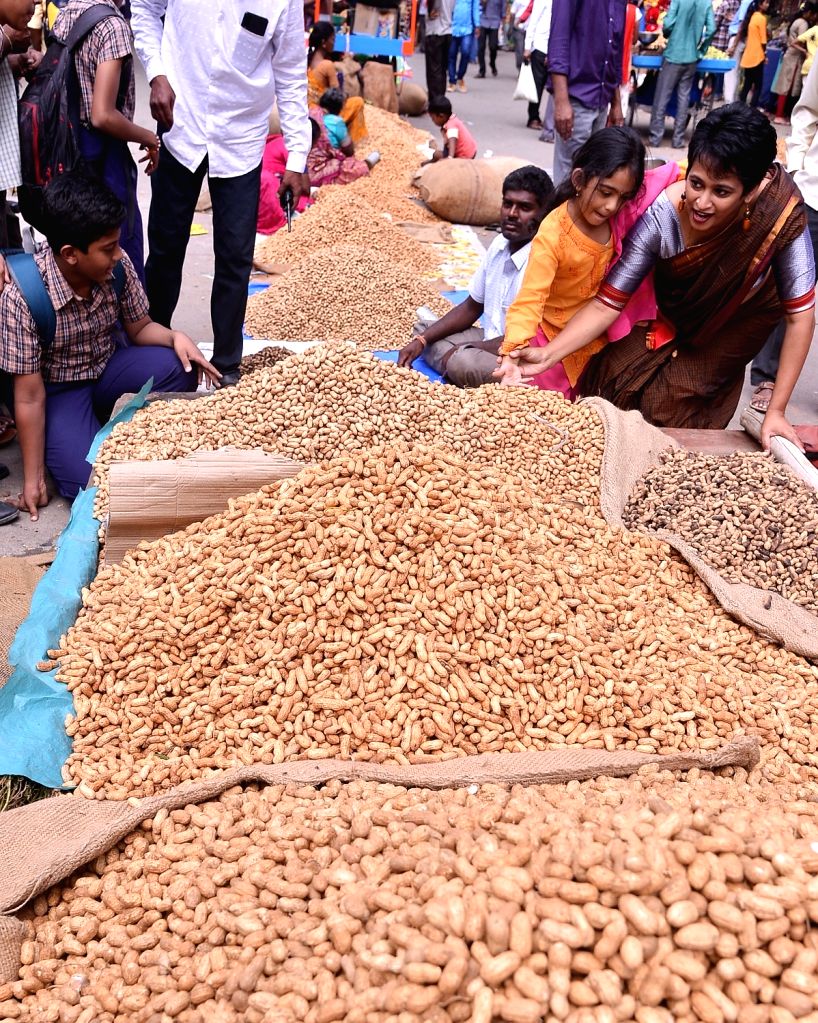
Every year, as the month of Karthika draws to a close, the historic neighbourhood of Basavanagudi in Bengaluru undergoes a remarkable transformation. Streets surrounding the Dodda Basavana Gudi, or Bull Temple, fill with farmers, sacks, baskets and enormous mounds of freshly harvested groundnuts.
For a few days, Bengaluru’s urban landscape acquires the unmistakable character of a rural Karnataka fair.
The smell of roasted peanuts fills the air. Farmers call out to customers. Children weave through the crowds. Families buy groundnuts by the kilogram. Vendors sell toys, bangles, handicrafts and traditional snacks. Temple bells mingle with the sounds of the marketplace.
And at the centre of it all sits Nandi—the sacred bull of Shiva.
The Ministry of Tourism describes Kadalekayi Parishe as a tradition dating back approximately five centuries, while Karnataka Tourism connects its history with the 16th-century foundation of the Bull Temple by Kempe Gowda. (Utsav)
What appears today to be a colourful urban fair is therefore something much deeper: a harvest offering transformed into one of Bengaluru’s most beloved living traditions.

Basavanagudi — Where Old Bengaluru Still Breathes
Long before Bengaluru became India’s celebrated technology capital, its landscape was marked by villages, fields, tanks, rocky hillocks and agricultural settlements.
Basavanagudi preserves a particularly evocative memory of that older Bengaluru.
The neighbourhood takes its name from Basavana Gudi—literally, the Big Bull Temple. The temple is traditionally associated with Kempe Gowda I, the 16th-century founder of Bengaluru, and Karnataka Tourism dates its construction to 1537. (Karnataka Tourism)
The temple houses a gigantic monolithic representation of Nandi, carved from granite.
Karnataka Tourism describes the Nandi as approximately 15 feet high and around 20–21 feet long, making it one of the most imposing Nandi images in the region. (Karnataka Tourism)


It is this sacred image that gives Kadalekayi Parishe its spiritual centre.
The festival is therefore not simply named after the crop.
It is named after a relationship:
farmer → harvest → Nandi → blessing → community.
The Legend of the Bull and the Groundnut Fields
Like many ancient Indian festivals, Kadalekayi Parishe carries a traditional legend explaining its origins.
According to the story, the area around present-day Basavanagudi was once surrounded by groundnut cultivation.
Farmers would work through the agricultural season, nurturing their crops until harvest approached. But a mysterious and powerful bull was said to enter the fields and destroy the groundnut crop.
The farmers were distressed.
Eventually, they turned to Basava, the sacred bull and vehicle of Lord Shiva.
They prayed to Nandi and began offering the first harvest of groundnuts to him.
According to the traditional account, the problem ceased, and the farmers continued the offering as an expression of gratitude.
Karnataka Tourism explicitly presents this as the traditional history of Kadalekayi Parishe, while also describing the story as a legend associated with the Bull Temple. (Karnataka Tourism)
The important point is not whether the story should be read as literal history.
Its cultural importance lies elsewhere.
It expresses an ancient agrarian idea:
The first fruits of the earth belong to the divine before they belong to the marketplace.
And that idea survives beautifully in Kadalekayi Parishe.
From First Harvest to Great Fair
The Kannada word kadalekayi means groundnut, while parishe means fair.
Thus, Kadalekayi Parishe literally means the Groundnut Fair.
What began as an offering of the first harvest gradually developed into a major community gathering.
According to the Ministry of Tourism, the traditional celebration is held around the last Monday of Karthika Masa, with the Gregorian date changing from year to year because the festival follows the Hindu lunar calendar. (Utsav)
Farmers arrive with their produce and first offer groundnuts at the Bull Temple.
Then the marketplace begins.
Bull Temple Road and the surrounding areas near Dodda Ganesha Temple and Bugle Rock become filled with stalls selling groundnuts of different varieties and qualities. (Utsav)
It is an extraordinary transformation.
A modern Bengaluru road becomes, for a brief period, a vast open-air agricultural market.
When the City Becomes a Village


Perhaps the most enchanting quality of Kadalekayi Parishe is its ability to temporarily change the personality of Bengaluru.
The city known for technology companies, glass towers, traffic and startups suddenly becomes a place of:
farmers, bullocks, baskets, sacks, roasted peanuts, village produce and traditional commerce.
Farmers and vendors occupy the streets with mountains of groundnuts.
Some are sold still in their shells.
Others are cleaned and sorted.
Visitors can choose between different varieties and grades, buying directly from the people who have brought the produce from the fields.
Karnataka Tourism describes this direct farmer-to-consumer character as one of the important features of the fair. (Karnataka Tourism)
This makes Kadalekayi Parishe more than a festival.
It is also a temporary agricultural marketplace.
And there is something culturally significant about seeing the producer standing directly before the consumer.
A Festival of the First Harvest
The first harvest has enormous significance in India’s agricultural traditions.
Across the country, harvest festivals celebrate the moment when months of labour finally become food.
Kadalekayi Parishe expresses this idea in a particularly intimate manner.
The farmer does not simply bring produce to sell.
The first produce is brought into the sacred space.
The offering to Nandi symbolically acknowledges:
- the fertility of the soil,
- the rains,
- the labour of the farmer,
- the animals that traditionally assisted agriculture,
- the forces of nature,
- and the divine blessing sought for the next agricultural cycle.
In this sense, the groundnut becomes much more than a commodity.
It becomes an offering.
Nandi — The Sacred Guardian at the Heart of the Festival
For devotees, the enormous Nandi of Basavanagudi is not simply an archaeological or architectural monument.
He is Basavanna—a living presence.
In Shaiva tradition, Nandi is the vahana of Shiva, but his role extends beyond that of a vehicle. He is associated with devotion, strength, guardianship and attentive presence before Shiva.
At Basavanagudi, this sacred symbolism becomes intertwined with agricultural life.
The traditional story transforms Nandi into a protector of the farmer’s livelihood.
The annual offering of groundnuts consequently becomes a ritual of gratitude.
It is one reason the Bull Temple cannot be separated from the identity of the festival.
Without Nandi, Kadalekayi Parishe would simply be a groundnut market.
With Nandi at its centre, it becomes a sacred harvest fair.
The Farmers Are the Real Protagonists
In the modern city, it is easy to forget how much human effort lies behind an ordinary food item.
Kadalekayi Parishe reverses that distance.
For a few days, the farmer becomes highly visible.
The person who cultivated the groundnut is physically present.
The sacks are visible.
The crop is visible.
The varieties are visible.
The transaction is personal.
The festival therefore creates a rare urban encounter between Bengaluru’s consumers and Karnataka’s agricultural communities.
Karnataka Tourism’s account of the 2025 festival noted participation from farmers from areas including Magadi, Tumakuru, Ramanagara and Chikkaballapur, as well as vendors from neighbouring states and regions. (Karnataka Tourism)
The exact participation varies from year to year, but the essential relationship remains the same:
the countryside comes to the city.
A Carnival of Food
Of course, no Indian fair is complete without food.
And Kadalekayi Parishe celebrates the groundnut in almost every imaginable form.
Visitors encounter:
- freshly harvested groundnuts,
- roasted peanuts,
- boiled groundnuts,
- salted varieties,
- peanut chikki,
- peanut-based sweets,
- groundnut chutneys,
- and numerous local snacks.
The 2025 Karnataka Tourism account also highlighted traditional fair foods and peanut-based preparations such as kadalekai holige, peanut ladoos and kadalekayi chikki. (Karnataka Tourism)
The humble peanut suddenly becomes the star of an enormous culinary theatre.
More Than Groundnuts — The Parishe Comes Alive
Kadalekayi Parishe is not only about agriculture.
It is also a traditional janapada—folk—fair.
The streets fill with stalls selling:
toys • bangles • handicrafts • household articles • decorative objects • children’s items • local produce
The Ministry of Tourism specifically lists handicrafts, toys, local delicacies and the nearby temples among the attractions visitors can experience during the fair. (Utsav)
For children, it can feel like an enormous carnival.
For older Bengaluru residents, it can evoke memories of a city that was much smaller and more intimate.
For farmers, it is an opportunity to bring their harvest into the heart of the metropolis.
And for visitors, it offers a glimpse of old Bengaluru that survives within new Bengaluru.
Dodda Ganesha and Bugle Rock — The Sacred Landscape Around the Fair
The Kadalekayi Parishe experience extends beyond the Bull Temple itself.
The fair occupies the cultural landscape around Dodda Ganesha Temple and Bugle Rock, two important landmarks of Basavanagudi. (Utsav)
The result is a remarkable concentration of heritage within a relatively small area.
A visitor can encounter:
Nandi worship → Ganesha worship → historic temples → rocky landscape → old neighbourhoods → traditional food → farmers’ market → folk commerce
all within the same festive walk.
This is one reason Kadalekayi Parishe works so well as a cultural tourism experience.
It is not an isolated event staged in a modern exhibition ground.
The entire historic neighbourhood becomes the festival venue.
The Soundscape of Kadalekayi Parishe
Every festival has its own sound.
Kadalekayi Parishe has a particularly urban-rural soundscape.
Temple bells.
Devotional chants.
Voices of vendors.
Children laughing.
The rustle of sacks.
The crunch of roasted groundnuts.
Street vendors calling out to customers.
The movement of thousands of people through narrow roads.
And, above it all, the unmistakable rhythm of a traditional Karnataka fair.
The sound is part of the intangible heritage.
So are the smells, colours, foods, rituals, memories and human relationships.
This is why documenting festivals such as Kadalekayi Parishe matters.
A festival is not only something one sees. It is something one hears, smells, tastes, touches and remembers.
Five Centuries — Yet Remarkably Contemporary
The Ministry of Tourism calls Kadalekayi Parishe a roughly 500-year-old festival, while Karnataka Tourism connects its origins to the 16th-century history of Bengaluru and Kempe Gowda. (Utsav)
Yet the festival has not remained frozen in the past.
It has adapted to the modern city.
The scale and duration have changed in different years. For example, the Ministry’s listing for 2024 described a two-day event, while Karnataka Tourism reported that the 2025 celebration was expanded to five days. (Utsav)
This adaptability is important.
Living heritage survives not because it refuses to change, but because communities continue to find meaning in it.
The form may change.
The crowds may become larger.
The city may grow around it.
But the essential ritual remains:
the farmer brings the first harvest to Nandi.
An Urban Festival with an Agrarian Soul
Bengaluru is now one of India’s most globally connected cities.
Its skyline, economy and population have changed dramatically.
Yet Kadalekayi Parishe reminds the city that beneath its contemporary identity lies an older landscape.
A landscape of:
fields rather than campuses,
farmers rather than software engineers,
bullocks rather than traffic,
temple bells rather than notifications,
and harvests rather than quarterly results.
For a few days each year, the old and new Bengaluru meet.
A technology professional can stand beside a farmer.
A child from a modern apartment can discover where groundnuts come from.
A visitor can walk into the Bull Temple and encounter a ritual whose roots stretch back centuries.
And a simple agricultural crop can become the centre of an entire city’s celebration.
Why Kadalekayi Parishe Matters as Living Heritage
Kadalekayi Parishe deserves to be understood not merely as an annual fair but as a remarkable example of living intangible cultural heritage.
It preserves several layers simultaneously:
Agricultural heritage
The festival keeps the memory of groundnut cultivation alive.
Religious heritage
The first harvest continues to be associated with Nandi worship.
Architectural heritage
The historic Bull Temple remains the spiritual centre.
Food heritage
Traditional groundnut preparations and local fair foods continue to attract visitors.
Folk heritage
The fair retains the atmosphere of a traditional Karnataka parishé.
Community heritage
Farmers, traders, families and visitors participate together.
Urban heritage
It preserves a memory of Bengaluru’s pre-modern agricultural landscape within a rapidly changing metropolis.
That combination makes Kadalekayi Parishe extraordinary.
When the Groundnut Becomes a Symbol
There is something deeply Indian about the way Kadalekayi Parishe elevates an everyday crop into a sacred and cultural symbol.
The groundnut is inexpensive.
It is familiar.
It is humble.
It grows beneath the soil, largely unseen.
Yet once a year, it emerges from the earth and takes over the streets of Bengaluru.
The farmer brings it.
Nandi receives it.
The city buys it.
Families eat it.
Children play around it.
And the memory of another Bengaluru lives through it.
Perhaps that is the greatest beauty of Kadalekayi Parishe.
It reminds us that heritage does not always live in palaces and monuments.
Sometimes it is found in a sack of freshly harvested groundnuts.
Sometimes it sits beside a farmer on the roadside.
Sometimes it is offered before a granite Nandi.
And sometimes an entire city gathers around it.
The Living Soul of Basavanagudi
When the Kadalekayi Parishe ends, the enormous piles of groundnuts disappear.
The temporary stalls are dismantled.
The streets return to their everyday rhythm.
Traffic resumes.
Bengaluru returns to its familiar modern identity.
But the festival leaves behind something more enduring.
It has once again connected the city with the soil, the consumer with the farmer, the present with the past, and the marketplace with the temple.
At the heart of Basavanagudi, Nandi remains seated in silence.
And somewhere beyond the city, farmers begin another agricultural cycle.
The next Karthika will come.
The groundnuts will be harvested again.
The first produce will once again make its way towards Basavanagudi.
And Bengaluru will once again become—
a sea of groundnuts.
The timing and duration can vary from year to year because the festival follows the Hindu calendar; visitors should check the year’s official announcement before planning a visit. (Utsav)