Introduction
There are villages in India where art is not something one goes to a gallery to see. It is painted on the walls of homes, created in courtyards, discussed across family thresholds and passed quietly from one generation to the next.
Jitwarpur, on the outskirts of Madhubani in Bihar, is one such place.
Known as one of the great centres of Mithila or Madhubani painting, Jitwarpur has produced generations of celebrated artists. Its walls and homes have become canvases, while its artists have carried the visual language of Mithila far beyond Bihar — into museums, exhibitions and collections across India and abroad.
In February 2026, Bihar Museum announced the foundation of Bihar’s first Shilpgram (Craft Village) at Jitwarpur, specifically intended to promote Mithila art, support artisans and strengthen the village’s infrastructure.
Jitwarpur is therefore not simply a village famous for a craft.
It is a place where a living painting tradition has become part of the identity of the community itself.


A Village Painted in Mithila Style

Walk through Jitwarpur and the first thing that catches the eye is colour.
Walls, doorways and open sitting areas can carry elaborate paintings filled with figures, birds, fish, flowers, trees, geometric patterns and mythological scenes.
A particularly beautiful aspect of the village is that the paintings are not necessarily presented as framed works of art.
The house itself can be the artwork.
Photographic documentation by Dastkari Haat Samiti records many mud-and-bamboo houses in Jitwarpur painted in the Madhubani style.
Recent reporting from the village describes painted dalaans — open sitting areas outside homes — and notes that certain colours and motifs continue to retain ritual significance. For example, artist Dhruvkala Devi explained that red motifs are traditionally used for wedding murals.
This is what makes Jitwarpur so different from an ordinary art centre.
The paintings belong to the visual life of the village.
What Is Mithila Painting?
Mithila painting, commonly known as Madhubani painting, is the traditional painting language of the Mithila region of Bihar and adjoining areas of Nepal.
Its visual vocabulary is instantly recognisable.
Human figures often have large, expressive eyes.
Bodies are surrounded by intricate patterns.
Empty spaces are filled with flowers, leaves, animals, birds and geometric designs.
Borders are carefully ornamented.
Mythological scenes can coexist with everyday life.
And the entire composition can be brought alive through a remarkable combination of line, pattern and colour.
The tradition developed in domestic and ritual settings, particularly around important occasions such as weddings and festivals. Over time, artists began producing the work on paper, cloth and other portable surfaces, allowing the tradition to travel far beyond the walls on which it was originally practised.
From the Walls of the Home to the World
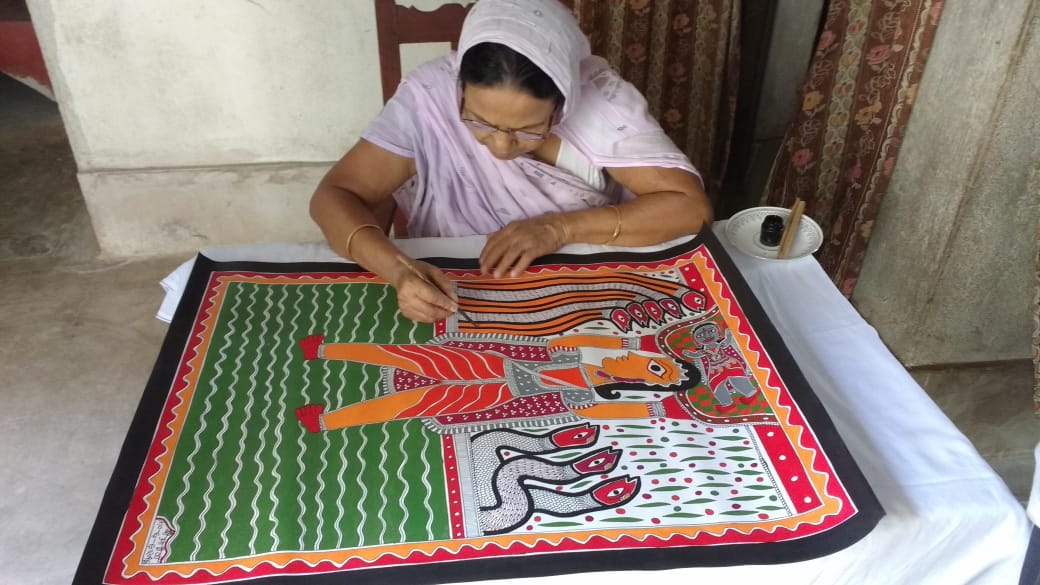

The transformation of Mithila painting from a primarily wall-based tradition into a widely collected art form is one of the most fascinating chapters in Jitwarpur’s story.
A particularly important period came in the 1960s, when officials and cultural researchers began documenting the paintings of the Mithila region and encouraging artists to transfer their work from walls to paper.
Artist Baua Devi recalled how, as a young girl, she and other women were given paper and asked to create paintings. This helped open a new avenue for the tradition.
The change was transformative.
A painting on a wall remained within the village.
A painting on paper could travel.
It could be exhibited in Delhi.
It could enter a museum.
It could be purchased by a collector.
And eventually, it could travel across the world.
The Women Who Put Jitwarpur on the Artistic Map
Jitwarpur’s story is inseparable from its remarkable women artists.
Among the most celebrated names associated with the village are:
Jagdamba Devi
Jagdamba Devi was one of the pioneering figures in the recognition of Mithila painting beyond the region.
Sita Devi
Sita Devi became one of the most influential Madhubani painters of the 20th century. She helped establish the artistic identity of the tradition on national and international platforms.
Baua Devi
Baua Devi, another celebrated artist from Jitwarpur, received the Padma Shri in 2017.
Her artistic career demonstrates how a village tradition could evolve into an internationally recognised form of artistic expression.
Bihar Museum notes that Jitwarpur has produced three Padma Shri recipients — Jagdamba Devi, Sita Devi and Baua Devi — as well as numerous national- and state-level award-winning artists.
A Village of Different Painting Styles
One of the interesting things about Jitwarpur is that Mithila painting is not one single visual formula.
Different artists and communities developed different approaches.
Among the styles associated with Mithila painting are:
Bharni
Bharni is characterised by areas of strong, filled colour within outlined forms.
Kachni
Kachni places greater emphasis on delicate line work, hatching and fine pattern.
Godna
Godna is associated with tattoo-inspired geometric and linear motifs.
Tantra
Tantric imagery forms another important strand within the wider Mithila painting tradition.
Bihar Museum’s description of Jitwarpur’s Craft Village notes that artists in the village practise Kachni, Bharni, Tantra and Godna styles.
This diversity is important.
It reminds us that Madhubani painting is a family of related visual traditions rather than a single rigid style.
The Kohbar — Painting Love, Marriage and Fertility


Among the most beautiful forms associated with Mithila painting is the Kohbar.
Traditionally connected with the wedding chamber, Kohbar paintings contain a rich vocabulary of symbols associated with marriage, fertility, prosperity and the continuity of life.
Lotuses, bamboo groves, birds, fish, celestial bodies and other motifs can appear within the composition.
The Kohbar is therefore not simply decoration.
It is a visual language of marriage and auspiciousness.
Traditional knowledge of Kohbar painting was transmitted through generations, with women learning by observing and participating in the creation of ritual paintings.
The Language of Nature


Look closely at a traditional Mithila painting and nature seems to fill every available space.
Fish swim through ornamental compositions.
Peacocks spread their feathers.
Birds perch among branches.
Lotuses bloom repeatedly.
Trees become elaborate architectural forms.
Elephants, horses, snakes and other animals appear alongside human figures.
This abundant use of nature is one of the reasons Madhubani paintings have such an unmistakable visual energy.
There is often very little empty space.
The artist fills the surface with life.
Gods, Epics and Sacred Stories
Religion is another major source of imagery.
Krishna, Rama, Sita, Shiva, Parvati, Durga and other deities appear frequently.
Scenes from the Ramayana and Mahabharata can be transformed into densely patterned compositions.
The figures are rarely treated as naturalistic portraits.
Instead, they become part of an ornamental universe in which mythology, nature and geometry exist together.
This makes the paintings simultaneously narrative and decorative.
A viewer can first admire the colours and patterns and then gradually discover the story within them.
The Artist at Work

The magic of Jitwarpur becomes particularly apparent when one watches an artist work.
The hand moves slowly.
A line is drawn.
Another line follows.
A figure begins to emerge.
Patterns gradually fill the surface.
There is rarely a sense of hurried execution.
The apparent simplicity of the finished painting can conceal an enormous amount of patience.
Traditional Mithila painting depends upon line, repetition and controlled pattern.
A tiny decorative element may be repeated dozens of times.
A border may require hundreds of individual strokes.
The result is a painting that rewards close looking.
The Painted House
Perhaps the most evocative experience in Jitwarpur is seeing the painted house.
A doorway may be surrounded by figures.
A wall may contain a tree of life.
A veranda may display wedding imagery.
Another wall may show birds and fish.
The architectural structure becomes the frame.
This practice also connects contemporary Jitwarpur with the older ritual tradition of painting domestic spaces.
Dastkari Haat Samiti’s documentation records painted houses and surroundings in Jitwarpur, while Vogue India‘s 2026 feature captures the continuing presence of murals on village homes.
Jitwarpur’s Artists and the Challenge of Continuity
Behind the vibrant walls lies a more complicated story.
Traditional art communities must constantly negotiate between heritage and livelihood.
Younger members of artisan families may seek education and employment elsewhere.
Commercial demand can encourage repetition of popular designs.
Synthetic colours and contemporary materials may replace traditional ones.
Middlemen can affect the prices artists receive for their work.
A 2018 report on Jitwarpur highlighted concerns among painters about receiving a fair share of the value generated by their art.
A 2026 Vogue India report similarly observed that migration of younger generations has made continuity of the tradition an important concern for the village.
These challenges make Jitwarpur’s continued artistic activity all the more significant.
A New Chapter: Jitwarpur as a Craft Village


Jitwarpur entered a new phase in 2026 with the foundation of Bihar’s first Shilpgram, or Craft Village.
The Bihar Museum says the project is intended to promote Mithila art, support local artisans and improve infrastructure. The project has been supported by the Ministry of Textiles and Bihar Museum, with an announced cost of ₹9.02 crore.
This is significant because heritage tourism works best when visitors can encounter the artists and the community, rather than simply purchasing objects removed from their cultural context.
If developed thoughtfully, Jitwarpur has the potential to become an important destination for people interested in India’s living artistic traditions.
The Madhubani Railway Station — Art Beyond the Village


The influence of the region’s artists can be seen beyond Jitwarpur itself.
The Madhubani railway station has been extensively decorated with Madhubani paintings.
Dastkari Haat Samiti’s documentation describes the station as painted inside and outside by groups of Madhubani artists, with mythological scenes covering its walls.
This is an interesting transformation.
A traditional art form that once decorated domestic walls now decorates a public transport space used by thousands of people.
The art has moved from the private sphere into the public landscape without losing its distinctive visual identity.
A Family Tradition
Mithila painting has traditionally been transmitted through families and communities.
Children grow up surrounded by paintings.
They see parents and grandparents drawing.
They learn motifs by observation.
They begin with simple forms.
Gradually, they acquire the vocabulary of line, colour, composition and symbolism.
Dastkari Haat Samiti’s documentation of Jitwarpur includes an artisan family — artist Sunil Kumar Jha, his wife Devi Sangeeta Jha and their children — presenting their work together.
That photograph captures something fundamental about Jitwarpur:
the artwork is also a family inheritance.
Jitwarpur and the Wider Mithila World
It is important not to imagine Jitwarpur as the only home of Mithila painting.
The tradition extends across numerous villages and communities in the wider Mithila region.
Other important centres include Ranti, Rasidpur, Rajnagar and surrounding areas.
What makes Jitwarpur particularly remarkable is its concentration of celebrated artists and the strength of its association with the modern history of Madhubani painting.
The Centre for Cultural Resources and Training, for example, documents several noted Madhubani artists from Jitwarpur, including Baua Devi, Karpuri Devi and Mahasundari Devi.
Why Jitwarpur Matters
Jitwarpur is important not merely because it produces beautiful paintings.
It matters because it allows us to see how an Indian art tradition actually lives.
It lives in the home.
It lives in the family.
It lives in ritual.
It lives in memory.
It lives in the hands of the artist.
And increasingly, it lives in galleries, museums, public buildings and collections around the world.
The village therefore offers something that a museum cannot completely reproduce.
A museum can show us a magnificent Madhubani painting.
Jitwarpur can show us the cultural landscape that produced it.
Visiting Jitwarpur
For a traveller interested in Indian art and heritage, Jitwarpur is best approached slowly.
Rather than simply buying a painting, spend time observing the village.
Look at the walls.
Notice the doorways.
Visit artists’ homes and studios where appropriate.
Talk to artists about their work.
Observe the difference between a ritual mural and a painting created for contemporary collectors.
And, wherever possible, buy directly from artists or established community initiatives, so that the value of the tradition reaches the people who continue to practise it.
The village is only a short distance from Madhubani town, making it particularly interesting for travellers exploring the wider cultural landscape of northern Bihar.
A Village That Became a Canvas
There is a beautiful paradox at the heart of Jitwarpur.
The paintings that once belonged primarily to domestic rituals became internationally recognised.
The walls of village homes became the starting point for works that eventually travelled to museums.
Women who painted within the intimate world of the household became celebrated artists.
And a village once known mainly within Mithila became an important name in the history of Indian folk and traditional art.
Yet, despite all this recognition, the essence of Jitwarpur remains remarkably simple.
A wall.
A brush.
A few colours.
A patient hand.
A story.
And a tradition passed from one generation to another.
Jitwarpur is not simply a village of Madhubani painters. It is a living canvas of Mithila’s cultural memory.
Bihar Museum — Craft Village Jitwarpur
Google Arts & Culture — Madhubani Painting of Bihar
Vogue India — Jitwarpur and its Madhubani heritage
D’source, IIT Bombay — Madhubani Paintings of Bihar