Categories
Uncategorized

Molela Terracotta: Rajasthan’s Living Tradition of Clay, Faith and Storytelling

Spread India's Glorious Cultural & Spiritual Heritage

ॐ श्री गुरुभ्यो नमः ॐ श्री शिवानन्दाय नमः ॐ श्री चिदानन्दाय नमःॐ श्री दुर्गायै नमः 

Source of all Images in this Blog-post : Google Images : ‘Google Image Search’ will reveal the multiple sources of every single image shared here. For more details, kindly see ‘Disclaimer

Introduction

In a quiet village in Rajasthan, clay becomes something far more profound than an object of everyday use. It becomes a deity, a folk hero, a horse, a story, a memory and an offering.

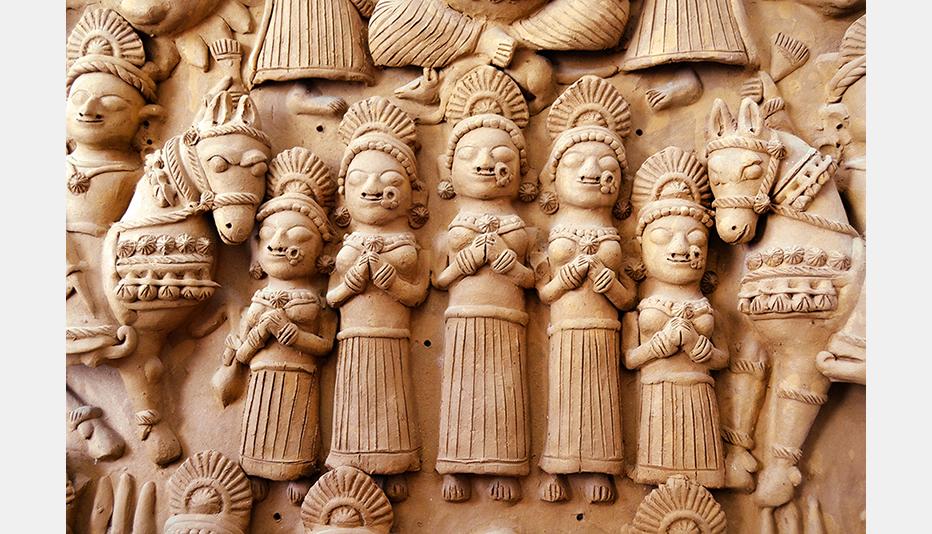
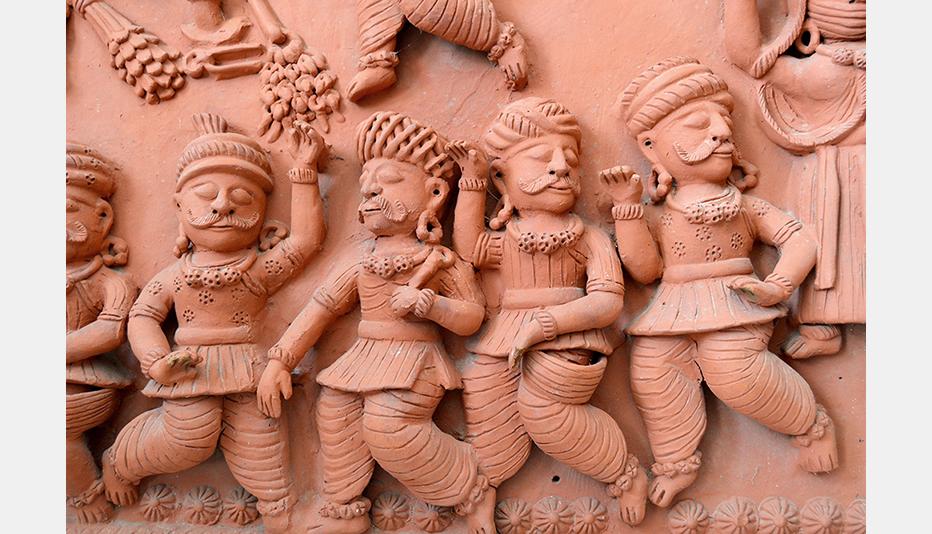
This is Molela Terracotta, one of Rajasthan’s most distinctive traditional arts. Practised for generations by hereditary potter-artisans in the village of Molela in Rajsamand district, near Nathdwara, the craft is celebrated for its extraordinary hand-modelled terracotta plaques and relief sculptures.

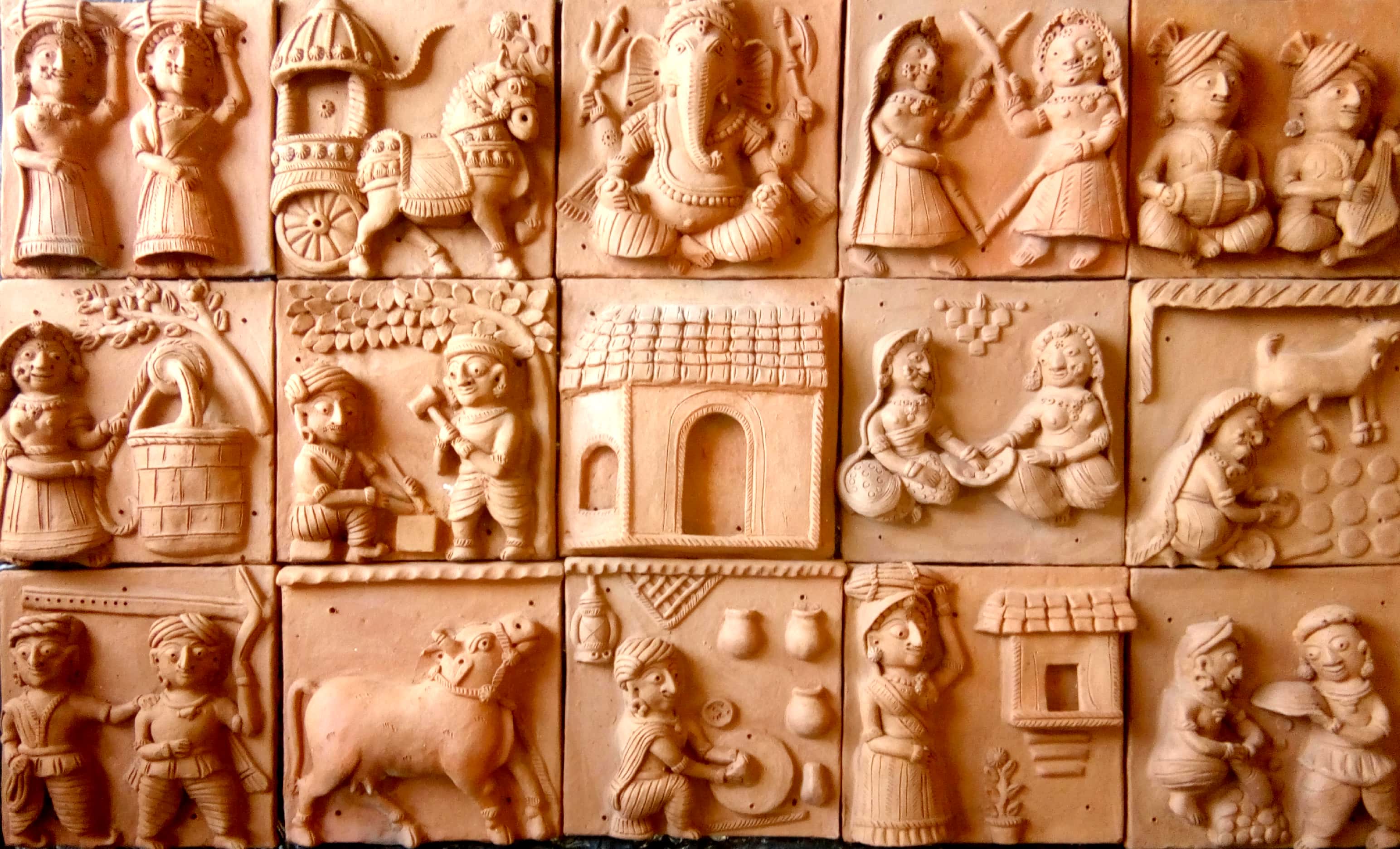
Unlike ordinary pottery, Molela is not primarily about vessels. Its artistic identity lies in transforming a flat clay surface into an intricate world of gods, goddesses, legendary heroes, animals, warriors and scenes from everyday rural life.

At its heart, however, Molela is a sacred tradition—a remarkable example of how art, belief and community can remain inseparably intertwined.

A Village Famous for Clay

Molela lies in the Mewar region of Rajasthan, close to the Banas River. The availability of suitable local clay helped create the conditions for a distinctive pottery tradition, but geography alone cannot explain the extraordinary character of Molela art.

For generations, the village’s Kumhar (potter) community has developed a highly specialised technique of modelling clay into hollow relief plaques.

These plaques traditionally served as votive images. Tribal and rural communities from parts of Rajasthan and neighbouring Gujarat would come to Molela to obtain sacred plaques representing their chosen deities.

The artisan therefore was not simply making an object for sale.

He was creating an image that could become the focus of worship.

When Clay Becomes Sacred

One of the most fascinating aspects of Molela is its connection with the religious traditions of Rajasthan’s tribal and pastoral communities.

Among the most important figures represented in Molela terracotta is Dev Narayan, a revered folk deity associated particularly with the Gurjar community. Other important subjects include Dharmaraja, Nagdevta, Bhairava and various manifestations of Hindu gods and goddesses.

Traditionally, a community or family seeking a votive plaque could approach a Molela artisan, sometimes accompanied by a bhopa, the traditional priest-singer or bard.

The choice of the deity and the form of the plaque was therefore connected to ritual and belief.

Once completed, the plaque could be taken back to the community and installed at a shrine.

Thus, a Molela plaque was not originally conceived simply as decorative art.

It had a life beyond the artisan’s workshop.

It could travel from Molela to another village, become part of a sacred space and participate in the community’s religious world.

The Extraordinary Art of Relief Sculpture

What immediately distinguishes Molela from conventional terracotta pottery is its sculptural technique.

The artisan begins with a prepared slab of clay that forms the basic surface of the plaque. Figures and decorative elements are then built up by hand.

Clay is pinched, rolled, pressed, coiled and modelled to create the different components.

A horse may emerge from the surface.

A deity may be shown seated majestically on a mount.

A warrior may carry a weapon.

A serpent may wind across the composition.

Architectural forms, jewellery, clothing, animals and vegetation can all be painstakingly added.

The result is neither a painting nor a conventional sculpture.

It is a three-dimensional narrative carved and built upon a clay surface.

The artisan must understand proportion, balance and composition while also ensuring that the plaque remains structurally sound during drying and firing.

Hollow from Within

Another remarkable characteristic of traditional Molela plaques is that they are generally hollow rather than solid.

This is an ingenious technical solution.

Large solid pieces of clay are much more susceptible to cracking during drying and firing. By creating hollow forms, Molela artisans can produce relatively large and elaborate sculptures while reducing the amount of clay and the stresses associated with firing.

The technique also gives the finished works a remarkable lightness relative to their apparent volume.

What looks like a massive sculptural composition may conceal a carefully engineered hollow structure.

From Wet Clay to Terracotta

The process begins with preparing the clay.

Local clay is cleaned and kneaded until it reaches the consistency required for modelling. The artisan then creates the base slab and begins constructing the composition.

The figures are built progressively, with small pieces of clay becoming faces, limbs, ornaments, weapons, animals and other details.

Fine decorative elements are often added with simple tools or directly with the fingers.

At this stage, the plaque is fragile.

It must dry slowly and carefully so that the different thicknesses of clay do not contract unevenly and produce cracks.

Once sufficiently dry, the work is fired in a kiln.

The transformation is dramatic.

The soft, earthy material becomes hard, durable terracotta.

The colour and texture of fired clay provide the foundation for the final visual character of the Molela plaque.

A World of Gods, Heroes and Animals

Molela’s visual vocabulary is remarkably expansive.

Traditional plaques may portray:

  • Dev Narayan
  • Dharmaraja
  • Nagdevta
  • Bhairava
  • Durga and other goddesses
  • Vishnu and different divine manifestations
  • Shrinathji
  • Episodes associated with the Ramayana and Mahabharata
  • Folk heroes and legendary figures
  • Horses, elephants, cattle, birds and serpents
  • Musicians and warriors
  • Village scenes
  • Marriage ceremonies
  • Rural occupations and everyday life

The horse is particularly prominent in the visual culture of Molela.

It is not merely an animal.

In many compositions it becomes the vehicle through which a deity, hero or supernatural figure enters the narrative.

The plaque therefore becomes a miniature theatre in clay, with figures arranged across its surface like actors in a story.

The Storytelling Power of Molela

Perhaps the greatest strength of Molela terracotta is its ability to tell stories visually.

A single plaque can contain several layers of meaning.

A central deity establishes the religious focus.

Surrounding figures provide narrative context.

Animals add movement.

Architectural elements establish a setting.

Ornaments and costumes communicate status and identity.

The artisan does not need written text to tell the story.

The story is embedded in the arrangement of forms.

This makes Molela an important part of India’s vast tradition of visual storytelling, in which sculpture, painting, performance and oral traditions have historically worked together.

Colour Gives the Clay a New Life

Although the earthy surface of terracotta is beautiful in itself, Molela plaques are often painted after firing.

Bright colours can transform the compositions dramatically.

Reds, yellows, greens, blues, whites and other colours highlight clothing, jewellery, animals and architectural details.

The contrast between the fired clay and painted surfaces gives Molela works their unmistakable folk aesthetic.

The colours also help separate the numerous figures and details within a complex composition.

The result can be exuberant, theatrical and intensely visual.

From Sacred Plaques to Contemporary Art

Molela’s story does not end with traditional votive plaques.

The craft has demonstrated an unusual ability to evolve.

Contemporary Molela artisans have expanded their repertoire to include larger panels, decorative works, murals and subjects drawn from contemporary life.

Traditional techniques may now be used to portray themes such as education, social change, women’s empowerment, occupations and modern rural life.

This evolution is significant.

It shows that preserving a craft does not necessarily mean freezing it in the past.

A living tradition can retain its techniques, materials and artistic vocabulary while responding to a changing society.

The Artisan as Sculptor and Storyteller

The Molela artisan occupies a fascinating position between several artistic worlds.

He is a potter because the tradition belongs historically to the Kumhar community.

He is a sculptor because he models figures and reliefs.

He is a storyteller because his compositions communicate myths and legends.

And, historically, he has also been part of a sacred economy in which his creations become objects of worship.

This combination makes Molela different from many other Indian terracotta traditions.

The artisan is not merely manufacturing a product.

He is participating in a cultural system in which craft, mythology, ritual and community memory intersect.

A Craft with a Geographical Identity

Molela’s distinctive character has been formally recognised through India’s Geographical Indication (GI) system.

Molela Clay Work received GI registration in 2008, helping establish the geographical and cultural identity of the craft.

The GI recognition is important because Molela’s artistic identity is inseparable from its place of origin.

The name “Molela” does not merely describe a style.

It evokes a particular village, a particular community of artisans, particular materials and a distinctive cultural history.

Challenges Facing the Tradition

Like many hereditary crafts in India, Molela terracotta faces the pressures of changing lifestyles and markets.

Traditional devotional demand alone may not always provide sufficient livelihood for younger generations.

Mass-produced decorative objects compete with handmade works.

Changes in ritual practices can affect the demand for votive plaques.

At the same time, transporting fragile terracotta sculptures, finding new markets and ensuring adequate returns for highly skilled artisans remain important challenges.

Yet Molela has an advantage that many traditional crafts lack.

Its visual language is extraordinarily adaptable.

The same technique that once produced a sacred plaque can produce a contemporary wall panel, an artistic installation or a work depicting modern life.

This adaptability offers one possible route for the tradition’s continued survival.

Why Molela Matters

Molela terracotta deserves attention not simply because it is beautiful.

It matters because it preserves several forms of knowledge simultaneously.

It preserves knowledge of local clay.

It preserves hereditary modelling techniques.

It preserves folk mythology.

It preserves memories of tribal and rural religious traditions.

It preserves visual storytelling.

And it preserves the intimate relationship between an artisan and the community for which he creates.

In an age of industrial production, there is something profoundly moving about an artwork that still begins with earth shaped by human hands.

A Living Heritage in Clay

Molela reminds us that India’s traditional arts cannot always be neatly divided into categories such as “craft,” “religion,” “sculpture” or “folk art.”

Sometimes they are all of these things at once.

A Molela plaque may begin as a handful of clay from the earth around a Rajasthan village. In the hands of an experienced artisan, that clay becomes a deity, a horse, a hero or an entire mythological universe.

It may then leave the workshop and enter a shrine, a home, a museum or a contemporary gallery.

That journey—from earth to art, from artisan to community, from tradition to the future—is what makes Molela terracotta such an extraordinary part of India’s cultural heritage.

Molela is therefore not simply a place where terracotta is made.

It is a place where clay remembers stories.

And as long as its artisans continue to shape those stories with their hands, Molela’s remarkable heritage will remain alive.

Crafts Unparalleled#5: Molela Artwork — Steemit
Terracotta Art of Molela, Rajasthan
D'source Design Gallery on Molela - Terracotta Tiles and Murals | D'source  Digital Online Learning Environment for Design: Courses, Resources, Case  Studies, Galleries, Videos
Terracotta Art of Molela, Rajasthan
470 Art & crafts-clay-murals, painted pottery and ceramics ideas in 2021 |  pottery, clay flowers, clay
Terracotta Art of Molela, Rajasthan
Unknown Facts about the universal Craft of Rajasthan; Molela Terracotta –  craftvillageblog
Terracotta Art of Molela, Rajasthan
D'source Design Gallery on Molela - Terracotta Tiles and Murals | D'source  Digital Online Learning Environment for Design: Courses, Resources, Case  Studies, Galleries, Videos
Terracotta Art of Molela, Rajasthan
Molela Clay Tablet- Wall Decor - directcreate.com
Terracotta Art of Molela, Rajasthan

**********************************************

More Posts on India’s Terracotta Crafts for Further Reading:

Pottery & Terracotta Clusters of India

Discovering the Beauty and Craftsmanship of Terracotta Jewellery: Redefining Indian Fashion with Ethnic Elegance

Crafting Elegance: The Enchanting Bankura Horses and Terracotta Treasures of Panchmura, West Bengal

Aurangabad, Gorakhpur: A Hub of Terracotta Art

Kumbakonam in Tamil Nadu: The Temple Town of Terracotta Art

The Timeless Art of Terracotta Pottery in Kutch, Gujarat

The Timeless Beauty of Bankura Terracotta Pottery: A Journey Through Tradition and Artistry

The Timeless Beauty of Mathura’s Terracotta Art: A Journey Through History

Terracotta Temples of Bishnupur, West Bengal: A Timeless Heritage

The Age-Old Terracotta Art of Madhya Pradesh: A Timeless Craft Tradition

Villianur Terracotta Works: Crafting Heritage in Puducherry

A Fashionista’s Delight: The Timeless Allure of India’s Terracotta Jewelry in Fashion

The Intricate Beauty of Terracotta Art: The Earthy Elegance of Indian Craftsmanship

Unveiling the Artistic Treasures of Gorakhpur Terracotta Handicrafts: A Unique Blend of Tradition and Creativity

Witness the Charm of Real Cute Bankura Terracotta Horses: The Artistic Legacy of Bengal’s Rich Culture

Terracotta Art of Rajasthan

Terracotta Art of Molela, Rajasthan


Spread India's Glorious Cultural & Spiritual Heritage

2 replies on “Molela Terracotta: Rajasthan’s Living Tradition of Clay, Faith and Storytelling”

Visit Molela: The most authentic way to purchase these terracotta artworks is by visiting Molela, a village near Nathdwara in Rajasthan. Here, you can meet the artisans, watch them create the plaques, and buy directly from them.

Art and Craft Fairs: Terracotta art from Molela is often featured at major Indian arts and crafts fairs. Events like the Surajkund Crafts Mela near Delhi or the Santa Fe International Folk Art Market in the USA might have these artworks.

Leave a Reply

Your email address will not be published. Required fields are marked *